By Michelle N. Amponsah, Tilly R. Robinson, and Neil H. Shah
During the Class of 2026’s four years as undergraduates, Harvard Yard became a field for pitched battles over the state of American higher education.
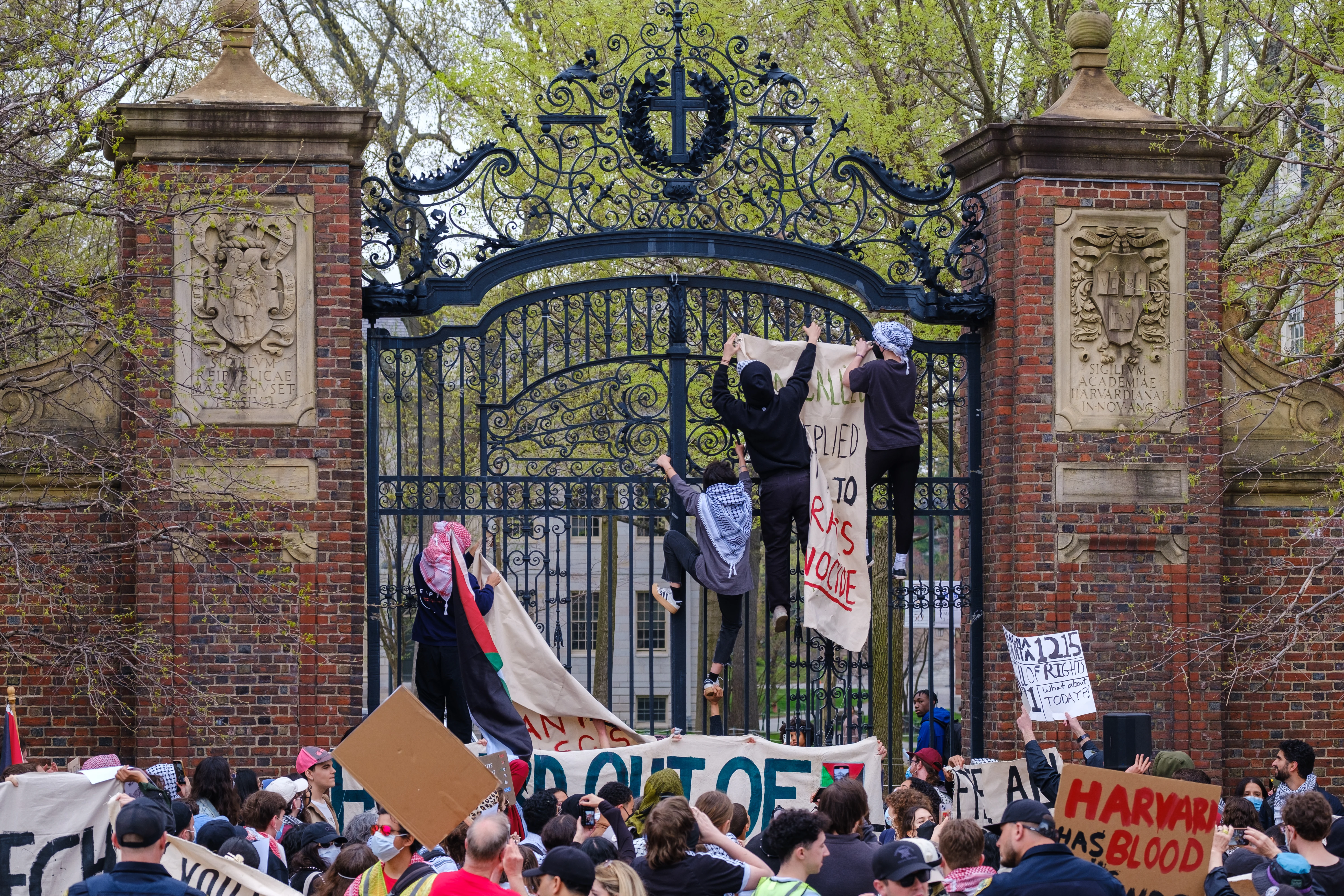
The summer after the class’s freshman year, affirmative action fell. The next year, campus erupted in protest after Hamas’ Oct.7, 2023 attack on Israel and the start of Israel’s war in Gaza, triggering the dramatic end to Claudine Gay’s Harvard presidency and a 20-day encampment. And the end of the Class of 2026’s time at Harvard — since President Donald Trump returned to office halfway through their junior year — has been punctuated by investigations, lawsuits, and punishments from Washington.
In all, the Class of 2026 has seen three University presidents, two College deans, and a battery of changes on campus. Within Harvard, administrators have tightened protest policies, shuttered diversity offices, and rallied faculty behind a cap on A grades.
Seniors who responded to The Crimson’s survey continued to show staunch support for the University’s two lawsuits defying the Trump administration. But the favorability of Harvard’s top officials, including University President Alan M. Garber ’76, has slipped since last spring.
Perhaps it would be too much to ask for the Class of 2026’s time on campus to end quietly. Since April 21, members of the Harvard Graduate Students Union–United Auto Workers have been on strike — canceling section meetings and office hours, and urging professors not to submit grades for graduating seniors in a bid to secure more favorable terms for the union’s third contract with the University.
Despite the disruption, seniors favor the union: Nearly 63 percent of respondents voiced support for the strike, while 18 percent opposed it.
Harvard’s Leaders
Garber’s favorability fell nearly 10 percentage points since last year, with just more than 49 percent percent of respondents saying they viewed him “very” or “somewhat” favorably.
In comparison, roughly 39 percent of respondents said they viewed former University President Claudine Gay favorably. Most members of the Class of 2026 were freshmen when Gay’s presidency was announced and sophomores when she resigned in scandal, returning to her faculty posts in the Government and African and African American Studies departments.
Less than a third of respondents — about 31 percent — indicated they believed Gay should not have left the presidency, consistent with the views of last year’s graduating seniors. Of the 45 percent who supported her resignation, two-thirds indicated they did so because the pressure on Gay and Harvard had grown too great, while one-third said they thought she was unfit to lead Harvard.
The Class of 2026 soured further on the Harvard Corporation, the University’s top governing body that entered the spotlight in 2024 for delaying the graduation of 13 members of the Class of 2024 who participated in the Harvard Yard encampment. Only 8 percent of respondents this year reported viewing the Corporation favorably, with just 1 percent indicating a “very favorable” view of the Corporation. Almost half of respondents to the Class of 2026 survey said they had neither a favorable nor unfavorable view of the Corporation or did not have enough information to respond.
Harvard College Dean David J. Deming received low marks after his first year in office, with only 32 percent of respondents indicating they saw him somewhat or very favorably. In comparison, Deming’s predecessor Rakesh Khurana consistently drew support from more than half of graduating seniors, with his approval rating never dropping below 40 percent.
But many seniors may simply be taking their time to warm up to University Hall’s new tenant: only 20 percent of students expressed an unfavorable opinion of Deming, while nearly half expressed a neutral view or said they didn’t have enough information.
Deming’s reputation among seniors may have suffered from his role as a face of the College’s efforts to tamp down grade inflation, spearheaded by Dean of Undergraduate Education Amanda Claybaugh. Claybaugh drew an even more negative response from the Class of 2026, with only 9 percent of respondents indicating they viewed her favorably. More than 53 percent of respondents reported viewing Claybaugh unfavorably.
Seniors also disapproved of Faculty of Arts and Sciences Dean Hopi E. Hoekstra, giving her an approval rating of less than 14 percent — more than a 10-point drop from last year. Hoekstra has led efforts over the past year to cut FAS spending, including anticipated staff layoffs, reductions to Ph.D. admissions, and the nonrenewal of non-tenure-track faculty positions. Nonetheless, Hoekstra’s role is not undergraduate-facing: 73 percent of respondents said they had neither a favorable nor unfavorable view of Hoekstra or did not have enough information to rate her leadership.
The Trump Administration
The Class of 2026 voiced overwhelming opposition to the Trump administration’s attempt to freeze Harvard’s federal funding and limit the University’s ability to enroll international students, with roughly 91 percent of respondents indicating an unfavorable view of both policies. Only 2 percent of respondents reported favorable views of the freeze or attempted enrollment restrictions.
Administration officials have justified their volley of punitive measures against Harvard by saying the University failed to protect Jewish students against antisemitism while pro-Palestine protests rocked campus. But students remained skeptical of the Trump administration’s claims: 82 percent of respondents described the Trump administration’s characterization of antisemitism at Harvard as exaggerated, including 58 percent who called it “very exaggerated.” Only 3 percent said the administration’s characterization was accurate or understated.
Respondents who identified themselves as Jewish were slightly more likely to accept the Trump administration’s characterization of antisemitism on campus, with around 10 percent describing it as accurate and 7 percent as somewhat understated. But a decisive majority — more than 80 percent — described the administration’s claims as exaggerated.
More than 77 percent of respondents to the Class of 2026 survey said they held unfavorable views of the Trump administration’s lawsuit claiming that Harvard violated federal civil rights law by failing to protect Jewish and Israeli students from harassment.
Harvard’s own legal fight against the Trump administration drew plaudits from the bulk of respondents: 81 percent indicated favorable views of Harvard’s lawsuit against the federal funding freeze, and a similar fraction supported Harvard’s lawsuit against international student restrictions.
But seniors were not as satisfied with Harvard’s support for international students themselves: only 16 percent of respondents said they thought Harvard had done enough to protect international students impacted by the Trump administration. About 38 percent indicated they thought Harvard had not done enough, and 46 percent said they were unsure or had no opinion.
Students from outside the U.S. expressed higher approval, at more than 35 percent, of Harvard’s international student protections.
Race and Religion
Hamas’ Oct. 7 attacks on Israel and the ensuing war in Gaza began halfway through the Class of 2026’s Harvard experience, shaking campus and drawing more than a year of national scrutiny over the University’s response to antisemitism and Islamophobia. But the Class of 2026 was generally skeptical of claims that bias — including antisemitism, Islamophobia, and racism — was pervasive on campus.
More than two-thirds of respondents to the survey — 68 percent — said that antisemitism was somewhat or very uncommon at Harvard. Just 2 percent said antisemitism was very widespread on campus, and 9 percent said that it was somewhat widespread. About 21 percent noted that they were unsure or had no opinion.
Respondents who self-identified as Jewish were split on how widespread antisemitism was at Harvard. About 52 percent said that antisemitism was somewhat or very widespread, while 48 percent said it was somewhat or very uncommon.
Seniors were more likely to believe that Islamophobia was prevalent on campus, with 30 percent describing it as somewhat or very widespread. But a plurality of respondents — about 46 percent — said Islamophobia was uncommon. Roughly a quarter said they were unsure or had no opinion on the prevalence of Islamophobia.
About 30 percent of respondents also said racism was somewhat or very widespread at Harvard, with 53 percent describing it as uncommon. White students were most likely to describe racism as widespread, followed by Asian and then Black students.
The Israel-Palestine Conflict
More than 54 percent of respondents said Harvard should divest from institutions with ties to Israel’s war in Gaza or Israeli settlements in the West Bank — an uptick of several percentage points from last year — while just 15 percent said Harvard should not divest.
The Class of 2026 was more split on the University’s disciplinary response to pro-Palestine activists and organizers. A plurality of respondents — roughly 43 percent — reported that the University’s response to protests was overly restrictive while just 12 percent said that Harvard administrators were too permissive toward protests. Roughly 14 percent said the University’s response was satisfactory.
Graduating seniors were also split on whether or not Harvard has a “Palestine exception” to free speech on its campus, a criticism pro-Palestine organizers frequently directed at Harvard’s administration at protests and in discussions with Harvard officials.
Approximately 40 percent of respondents said a “Palestine exception” to free speech exists while nearly a quarter of respondents said that Harvard does not have a “Palestine exception.” Roughly 23 percent said they were unsure and 13 percent said they had no opinion.
Free Speech and Campus Protest
Despite the many issues that have roiled campus over the last four years, most Harvard students will still graduate without having participated in a campus protest. Thirty-one percent of respondents reported participating in at least one protest on campus, with just over half of those students — 52 percent of them — having participated in a protest related to the Israel-Palestine conflict.
Most respondents reported having refrained from expressing political beliefs in a class setting because of how they believed classmates would react, and only 28 percent said they had never done so. Sixteen percent of respondents said they frequently did so, 29 percent said they did so sometimes, and 28 percent said they had done so at least once.
For most students, however, the pressure was more social than institutional. About 59 percent of respondents said they had never refrained from making a political argument in a class assignment or exam due to a belief that it could negatively impact their grade. Roughly 11 percent said they had done so frequently and 16 percent said they did so sometimes.
Conservative students were much more likely to say they frequently refrained from expressing political beliefs in class or on assignments and exams.
Graduating seniors largely indicated they did not support concerted efforts to increase ideological diversity on campus. Half of respondents said they did not believe Harvard needed a concerted effort to hire more conservative faculty, with 27 percent in favor. Respondents felt even more strongly about such efforts for the student body: 59 percent were against an analogous push for recruiting conservative students, with only 15 percent backing such an effort.
Diversity, Equity, and Inclusion
Last year, as Harvard clashed with the Trump administration, the University shuttered, restructured, and renamed offices associated with its diversity efforts.
Just under half of respondents — 49 percent — said they were against the moves, with 28 percent agreeing with them and 23 percent expressing no opinion. Approximately 61 percent of those who agreed with the reorganization said the moves were correct “to avoid drawing negative attention from the Trump administration,” as opposed to agreeing with the move in a vacuum.
Almost a third of respondents said they had benefited from diversity, equity, and inclusion efforts on campus in some way, while 7 percent felt they had been harmed by them. Most students — 61 percent — were either unsure, did not have an opinion, or felt unaffected by the efforts.
The past year’s changes included the summer 2025 consolidation of three Harvard College offices — the Women’s Center, the Center for BGLTQ Student Life, and the Foundation for Race and Intercultural Relations — under the banner of a new “Harvard Foundation.” About 52 percent of respondents opposed the consolidation, while 12 percent supported it.
The three centers each served a relatively small fraction of the class, but the administrative changes have reduced seniors’ interactions with the Foundation. Between 20 and 30 percent of respondents said they attended programming at each center, prior to the changes, approximately once per academic year or more. A slightly lower percentage of respondents said they had attended Harvard Foundation programs in the most recent academic year, following the consolidation.
Harvard’s Controversial Connections
A raft of documents that became public this winter exposed new details of the notorious sex offender Jeffrey Epstein’s pursuit of Harvard ties. Former University President Lawrence H. Summers, who maintained a close personal correspondence with Epstein until the latter’s imprisonment in 2019, resigned from his academic and administrative appointments at Harvard — but the fallout has otherwise remained limited.
More than two-thirds of respondents to the Class of 2026 survey said they believed Harvard has not adequately addressed its affiliates’ links to Epstein. Only 5 percent said they believed it has.
In July last year, a Harvard committee announced the conclusion of a two-year review of Winthrop House’s name, associated with two men named John Winthrop whom historians believe were slaveowners. The committee opted to drop the House’s first name but retain its last.
Seniors were split on the decision. Roughly 26 percent of students supported the change, while 27 percent believed the Winthrop name should have been removed entirely, and 13 percent believed the House’s name should not have been changed at all. Residents of Winthrop House were more likely to support the outcome of the review.
Campus Resources
Confidence in the Harvard University Police Department remained high, with 67 percent of respondents expressing trust in the department. Despite conflict in the department and the abrupt departure of Chief Victor A. Clay last spring, the numbers represent a continued recovery in trust in HUPD since it dropped sharply in 2021.
But trust in HUPD remained lower among Black students than in most other racial groups, with only 40 percent of respondents who identified themselves as Black saying they trusted the department.
Seniors’ overall trust in the Cambridge Police Department was slightly lower than trust in HUPD, with 57 percent of respondents saying they trust CPD. That marks its highest level since The Crimson began surveying seniors on trust in CPD.
Nearly 59 percent of respondents to this year’s survey indicated trust in Harvard University Health Services, a similar level compared to last year — though more than a quarter of students said they do not trust HUHS.
Seniors’ opinions on the Administrative Board mellowed compared to last year, with only a quarter of respondents indicating that they do not trust the Ad Board — a 10 percentage point drop in distrust. Compared to last year, more seniors said they neither trusted nor distrusted the Ad Board or did not have enough information to respond.
Trust in House staff was high among the Class of 2026: More than 79 percent of respondents said they trusted their House’s faculty deans, and three-quarters said they trusted their House’s resident dean. More than 82 percent of respondents said they trusted their House tutors.
About a quarter of respondents said they held a favorable opinion of Harvard’s Title IX policies, and about 22 percent indicated unfavorable views. More than half indicated they held a neutral opinion of Harvard’s Title IX policies or else did not have enough information to respond.
Of the 14 percent of respondents who said they had been sexually harassed or assaulted at Harvard, three-quarters said they did not report the harassment or assault.