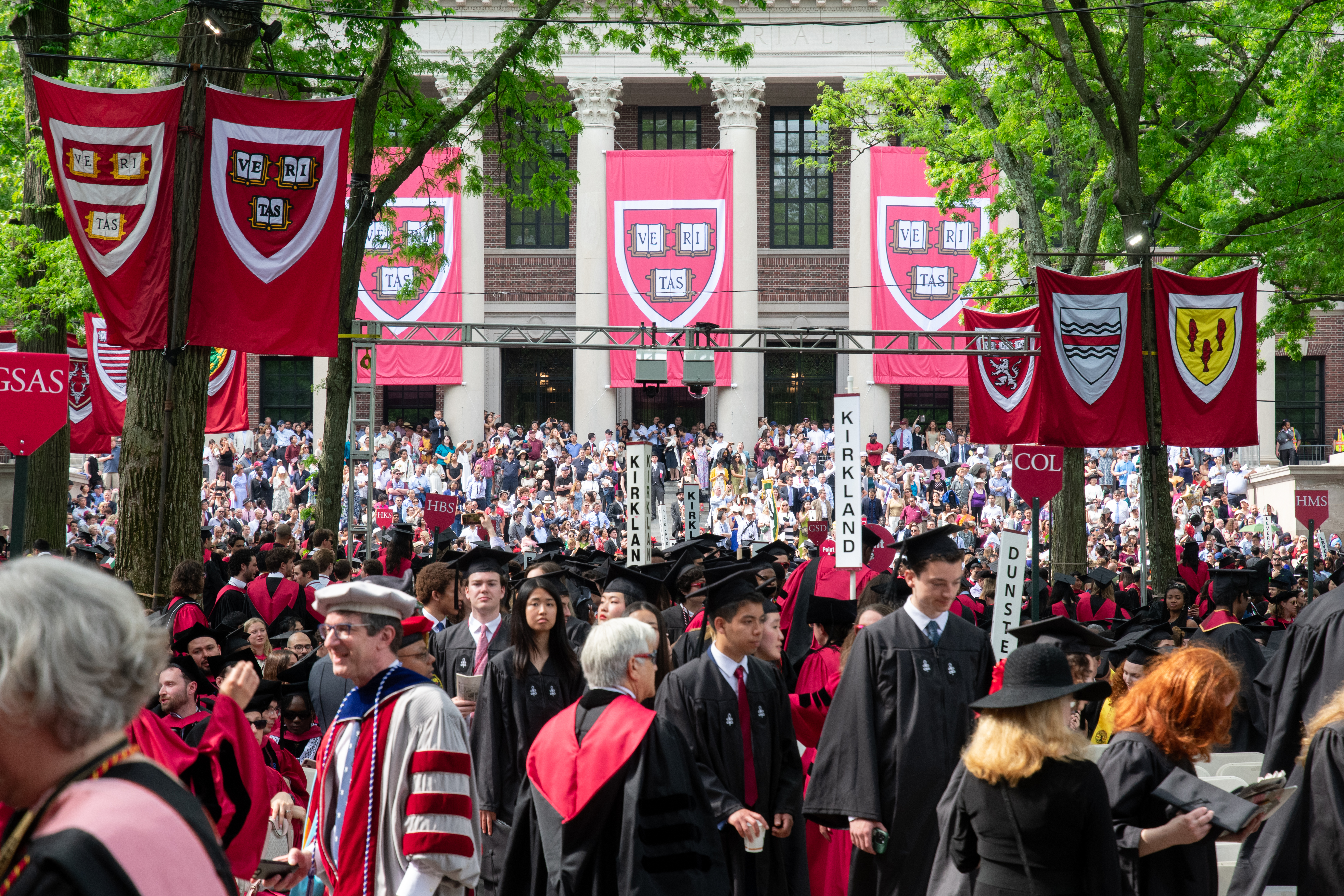
By the numbers, the Class of 2026 has witnessed an extraordinary
period of upheaval at Harvard: three University presidents, two
federal lawsuits and more than a dozen federal investigations, $2.7
billion in research funds lost.
Our class arrived just a few months before Harvard named Claudine
Gay as its 30th president, making her the first person of color to
lead the University in its nearly 400-year history. Days before she
took office, the Supreme Court struck down the use of affirmative
action for college admissions in a landmark decision against
Harvard.
Sophomore year for the Class of 2026 would prove pivotal for
Harvard. Just eight days after Gay’s inauguration in a September
downpour, the Oct. 7, 2023, attacks on Israel plunged Harvard into
months of grief and fury. Israel’s war in Gaza galvanized students
to protest, but their activism was also greeted with fears that
antisemitism was on the rise. Facing intense scrutiny and a divided
campus, Gay withered in an unprecedented leadership crisis for three
months before resigning on Jan. 2, 2024.
The Harvard Corporation chose then-Provost Alan M. Garber ’76 to
chart a new course: first as interim president, then on a three-year
clock, and finally as a permanent fixture. Garber’s hold on the
reins proved steadier, but his term, too, would be defined by an
escalating backlash against higher education.
President Donald Trump’s inauguration in January 2025 kicked the
crisis into overdrive. His administration continues to target the
University after blacklisting it from federal funds and attempting
to block its ability to host international students last spring.
The political reaction began to take hold in Cambridge as Harvard
dismantled its diversity offices and pushed out the leaders of
controversial academic programs. Meanwhile, campus leaders redoubled
their emphasis on “viewpoint diversity,” floating plans to change
the ideological composition of its faculty.
The student experience changed during the Class of 2026’s time at
Harvard, too: We were the last class to form linking groups before
Housing Day, to experience the adrenaline rush of an unsanctioned
River Run, and to register for classes only weeks before they began.
We benefited from one semester of free laundry before the imposition
of mandatory fees next year. And we watched longtime College Dean
Rakesh Khurana depart his role, replaced by the Harvard Kennedy
School professor David J. Deming.
Now, the Class of 2026 is leaving on the cusp of another set of
major changes to Harvard’s classrooms — narrowly missing reductions
in teaching staff, planned administrative layoffs, and a new cap on
awarding A grades. We are entering a workforce fundamentally
reshaped by artificial intelligence — a technology in its infancy
when we first stepped foot on campus.
The Crimson’s annual survey of the senior class captures our unique
view of an evolving campus. Recounting our political views, academic
records, social scenes, and future aspirations, the survey reviews
how graduates have changed during our time at Harvard — and how
Harvard has changed around us.
Methodology
The Crimson distributed the survey by email to 1,714 graduating
seniors and members of the social Class of 2026 using Harvard
directory information sourced in May 2026. Participants accessed the
survey form via personalized anonymous links from May 3 until May
15, 2026, when the survey closed. During that period, The Crimson
collected 680 surveys, representing a response rate of 40 percent of
those who received the survey.
The data includes academic and social seniors. 6 percent indicated
they matriculated earlier than 2022, meaning they took leaves of
absence from Harvard and later re-classed as members of the Class of
2026. Meanwhile, 4 percent indicated that they will graduate in
December of 2026 or later, meaning they affiliate as “Social
Seniors” but will not graduate with the majority of their class this
May. Overall, 10 percent took time off from Harvard.
To check for potential response bias, The Crimson compared
respondent demographics with publicly available information on
admitted student demographics provided by the University —
information regarding gender, race, and ethnicity. Overall, the
respondents to the survey were broadly in line with the demographics
of the student body. (Male students and Black students were slightly
underrepresented relative to their proportions in the class that
matriculated to Harvard, and Asian students were slightly
overrepresented. Harvard does not publicly release data on the
current demographics of its student body.) The data was not
otherwise adjusted for response biases.